
Leadership in Health Professions Education b.)
Demonstrate leadership in health professions education through innovation, mentorship, and reflective practice.
Artifact Reflection:
Final Capstone Project/HPTT 823 Leadership in Health Professions Education
Working on this leadership project has been a great opportunity for me to reflect on how my clinical experience has shaped the way I lead. Scanning for over 15 years in patient care, I’ve viewed leadership through a practical scope. This project helped me take a step back and connect those experiences to formal leadership concepts such as servant leadership, coaching, and the importance of human relations.
One of the most valuable takeaways for me was recognizing how intentional leadership needs to be. In the past, I think I naturally leaned toward supporting others and building relationships, but this project helped me understand why those approaches are effective and how to apply them more consistently. It also pushed me to think more strategically about preceptor development, rather than relying on informal or inconsistent methods.
I also gained a deeper appreciation for the role of communication and trust in building teams. In a clinical environment where time is limited and expectations are high, strong relationships and clear communication can make the difference in both team dynamics and student outcomes.
Overall, this project reinforced my belief that leadership is less about authority and more about supporting others. Moving forward, I plan to be more intentional in how I mentor, communicate, and create environments where both students and preceptors feel confident, valued, and empowered to succeed.
Artifact Reflection:
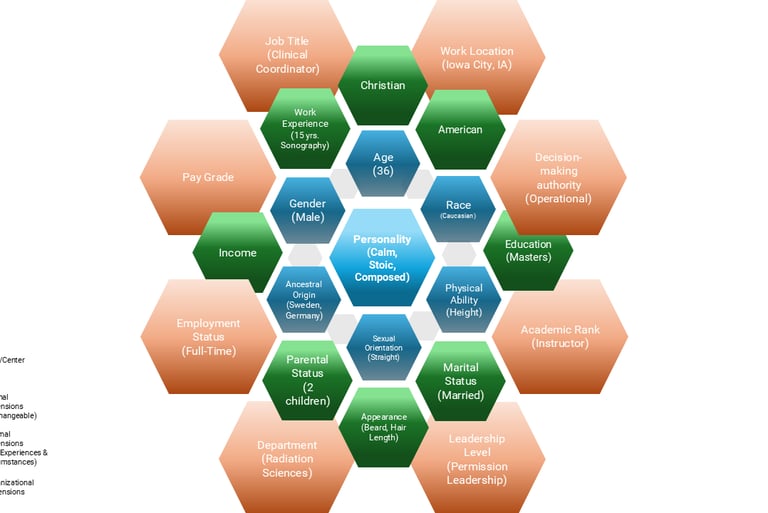
Diversity Wheel and Leadership Reflection/HPTT 823 Leadership in Health Professions Education
Creating my diversity wheel gave me the opportunity to step back and really examine what shapes me as both a person and a leader. It helped me recognize that my leadership style is not just influenced by my role as a Clinical Coordinator, but also by my personality, life experiences, and values. Identifying dimensions such as my calm and stoic nature, my experience in sonography, and my role as a parent made me realize how much these factors influence how I communicate, make decisions, and support others.
This process also pushed me to reflect on areas where I can grow. While I value consistency and composure, I recognize that my position and personality could unintentionally limit input from others if I am not intentional. It reminded me of the importance of actively creating space for different perspectives, especially from students or colleagues who may feel less comfortable speaking up.
Writing my diversity statement and thinking through how I communicate my values helped me see that inclusion cannot just be something I believe—it has to be something I consistently demonstrate. I also began to think more critically about how my decisions, particularly around evaluations and clinical placements, can impact fairness and equity.
Overall, this assignment helped me better understand myself and challenged me to be more intentional in how I lead, with a greater focus on inclusion, awareness, and continuous growth.
Click image to zoom in

Teaching
Health teaching professions and technology with 15 years of sonography experience
Zach Larson
zachary-larson@uiowa.edu
© 2024. All rights reserved.
Contact
319-356-7734